Research point
the tondo


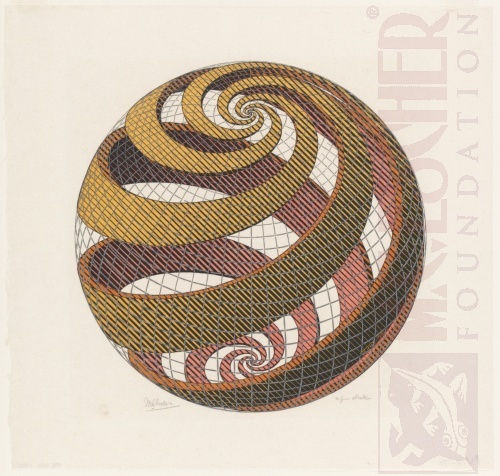


figures 1 - 11
I have chosen the above tondo pieces from different artists across the centuries. However, before I examine some of these pieces, I want to think about this circular support.
I read about the tondo Reading Rounding up the Story of Tondo in Art
What do we know about tondos?
-
Initially found in Ancient Greek times.
-
Were gifts to pregnant women in the form of decorated trays.
-
Renaissance humanists likened the circle shape to God himself, and from the 16th century, circles formed the ground plans for Churches. (I have seen many, especially in South America.)
-
Tondos were religious images with less importance placed on the background.
In his art journal, William Zimmer writes with regard the tondo,
The tondo is the most harmonious, most self-contained of shapes, but it is also the most radically demanding. The shape comes first, and content submits to it, or else baulks in opposition. “The window on the world”, the traditional trope for rectangular paintings, does not apply. In rectangular paintings, the window is supposed to disappear in favour of what we see through it. In a tondo, shape imprints itself, commanding all (Zimmer, 1991).
The circle or round is symbolic in different cultures:-
-
The ouroboros is an ancient symbol depicting a serpent or dragon eating its own tail, often interpreted as a symbol for eternal cyclic renewal or a cycle of life, death, and rebirth.
-
A mandala is a symbol of the universe for many Buddhists and Hindus. Most mandalas have colourful, detailed geometric patterns or designs. Mandalas are a religious and spiritual art with a deep significance for many people.
-
The wheel is a symbol of motion and continuity.
-
The principle of Yin and Yang is that all things exist as inseparable and contradictory opposites, for example, female-male, dark-light and old-young.
-
The spiral is found in all cultures and represents the cycle of life; birth, growth, death, and reincarnation. Spiritually the spiral represents connectivity with the divine, spiralling from the outer ego (the outside world) into the inner soul (cosmic awareness and enlightenment).
-
A labyrinth is an ancient symbol that relates to wholeness. It combines the imagery of the circle and the spiral into a meandering but purposeful path. The Labyrinth represents a journey to our own centre and back again out into the world.
-
The Flower of Life is one of the basic sacred geometry shapes. The Flower of Life symbolizes creation and reminds us of the unity of everything: we are all built from the same blueprint.
-
Enso is a sacred symbol in Zen Buddhism, meaning a circle, or sometimes, a circle of togetherness. It symbolizes strength, elegance, and one-mindedness.
-
What do I think about the tondo?
I think of the tondo not just as the apparent circle of life, eternal, infinite or whole, but also as looking through, say down a telescope, porthole or through a keyhole perhaps. I also imagine planets, stars and the world, and they fit with a circular spherical format also time and clock faces. Objects enclosed within a circle are restricted, as with road signage, or could the ring be a shell to protect the things? Or a view of looking into or out of something, am I concealed behind the circular hole? Figure 4, Anna Lena by Mark Fairnington this eye is looking at you, but the person is covered/concealed.
Whilst I read The Poetics of Space, my imagination is set free, and I can see spaces differently, which is interesting. Writing down my initial thoughts now leads to concepts for paintings, which sparks my imagination in my painting practice. Is this how it works, then; it’s just like experimenting in my sketchbook but with the written word. Developing my resource base whilst researching artists is not only expanding my toolkit but feeding my imagination.
Looking more deeply at the tondos chosen above, it seems that finding a focal point is difficult in the tondo composition, and I see a triangle within the placement of the three portraits (heads) in Figure 2 Doni Tondo by Michelangelo.
Geometrics are also present in Figure 7 Relational Painting Tondo number 35 by Fritz Glarner and Figure 9 Blue Tondo by Ilya Bolotowsky, but they are apparent and compliment the shape. Picasso and Braque also used this complement in a type of frame for their cubist works.
Figure 6 Byzantine Head The Brunette by Alphonse Mucha stands out as a unique piece for me. I instantly recognised the Art Nouveau style of this artist, reminding me of being in Paris or Prague. However, Mucha resented being labelled as Art Nouveau because that was too contemporary, and he preferred a timeless ‘le style, Mucha’. He uses a limited palette, depicting the feminine form surrounded by florals, the works mostly created for advertising and his designs copied on tins, posters and decorative product packaging. I can see many circles in his pieces; the arched top used on his long tall poster designs, but where has the influence come from for these circles?
The answer is Moravian folk arts, Baroque and Byzantine architecture (domes and arches) from his Slavic roots and heritage.
Moravian craftwork was used as inspiration for this particular painting. We see the woman wearing exotic and magical hair ornaments and a complex circular intricate pattern in the background. Looking at Moravian traditional art, I can see from the patterns and the floral 2D shapes how a beginning has formed and been developed. It also has similarities to the mandala.
I enjoy the painting for its original style and the fact that the circle has been broken by the hair falling over the bottom of the frame.
Some of the artists chose a fish eye approach to surround their work, some a flat black background to focus the eye on the subject, perhaps? Some chose flat geometrics, and some bring the spherical shape within the tondo to life with depth in their composition. Whichever approach is used, I like the shape of the unusual canvas for my work.
I remember seeing a painting in Lisbon by Frank Stella (below). It's not a tondo, but the round edges and unusual canvas shapes made an impression on me. Why is most canvas rectangular or square? Maybe I will change my mind when I attempt my own tondos.

figure 12
Frank Stella Hagamatama II 1967 (Background wall painting)
frank stella
American born 1936
 |  |  |
|---|---|---|
 |  |
figures 13 - 17
With deeper research into Frank Stella, I discovered he moved on from his black paintings and made several connected tondos, particularly his Protractor series. This series connects interesting shapes and colours to create a narrative from fluid abstraction, the sense of movement or activity. I enjoy the shaped canvas with their angled planes of vivid or pastel colour. I was interested in the fact that coloured paper, corrugated cardboard, and even felt-covered some pieces. These are hard-edged works that pack a punch, did Stella influence Pop Art? Stella went onto make sculptures, are they a transition period for him?
Much of his work has a geometric content, and some relate to Celtic geometry forms, Persian patterning (Stella visited Iran and Asia in 1963). Nevertheless, the structure of his pieces is always surprising.
In the online article;
THE JUSTIFICATION OF MODERNIST PAINTING: A REVIEW OF FRANK STELLA: EXPERIMENT AND CHANGE
Nathan Timpano writes about the impressive span of Stella's six decades of work and celebrates Bonnie Clearwater (director and chief curator of the NSU Art Museum) for his curation.
I would like to see Stella's studies, models, diagrams, and notebook sketches mentioned in the article as I expect this would be similar to a tutor reading through and viewing a student's sketchbook (introducing the inner workings of the artist's mind).
I found it intriguing that Stella leaves pencil marks on his canvas. But, as the article discusses, is this to make sure the viewer sees the human element?
From the work I have viewed, I expect Frank Stella to be frequently returned for inspiration.
The pastel and vivid colour choices, irregular shapes and innovative imagination of the artist stir up thoughts in my enquiring mind. He pioneered most of these techniques and the video below explains some of the questions I have asked, with regard to this artists long-spanning career. Change and constantly searching for a different way to create is another influence I would like to carry forward from my research on Frank Stella, to exhaust my experiments and then move on perhaps?
domestic interiors
What can we learn from images or paintings of domestic life?
Domestic activities are a major role in virtually every culture. Homes across the globe provide artist concepts for art with or without the inhabitants of those interior spaces. The time and place depicted has a massive impact on the narrative and communicates much more than one may think i.e. social ideals and cultural values are to be considered.
What do our homes say about us?
From travelling the world, I realise that every culture has very varied and differing 'domestic needs', each though, has the fundamental need for shelter. Each shelter is filled or the interior decorated in some shape or form. The wall painting and frescos adorning the walls in Pompeii, The Great Masters commissions to paint art to hang and be admired by visitors. From furniture to wallpaper, vases to floor coverings what is the meaning of these objects? Whom are they used by and why, and is this something I want to communicate?
pierre bonnard
french born 1867
 |  |  |
|---|---|---|
 |  |
figures 18- 22
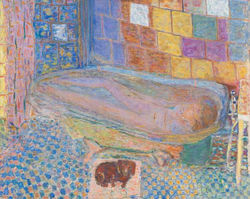
My choices of Pierre Bonnard's romantic, sensitive and enchanting pieces are full of love. The colours and sometimes jittery marks are complex, yet not if that makes sense?
I completely understand how these delightful images aren't for everyone. However, they are glorious to me because of the warmth and beauty they exude. The compositions are complex, and again not, the light is captured with glowing hues in a luminous and comforting manner. Nude in a Bathtub actually makes my heart sing. From the wobbly, irregular coloured tiles on the wall to the almost Pointillist style flooring, there is so much to view and compute. The intrigue and variation of the colour, composition and directional mishaps that all gather to a small dog in the centre foreground are so captivating that you almost overlook the nude.
Each artwork I have chosen is full of joyful colours, and the compositions intrigue me because of the small details and patterns, mark making and visible strokes of the applications.
tory day
british born
 |  |  |
|---|---|---|
 |  |  |
figures 23- 28
Tori Day's work is based around the words of Norman Bryson and in his book ‘Looking at the overlooked’ (1990). The book has an interesting influence on Day's work and her humble objects that have scratches and blemishes from their past. Bryson's book highlights the trivial and mundane aspects of daily life and the narrative associated with still life objects. Bryson implies a feeling in still life images, a feeling that these objects have been overlooked somehow and that they have an 'unconscious force' around them. I skimmed through the book and made a note of Georgio Morandi's name as I had researched him before and enjoyed his work (which had come to my mind when I first saw Day's still life works).
I enjoy Day's interest in where the objects have been and from where they have travelled. It reminded me of my shoe image 'GlobeTrotters- Rendez-shoe' and the imaginary/communication between those objects. Day has painted the objects have meaning, and without that meaning, they would be just objects.
I was intrigued by the work. For example, in Beryl, we are looking up at a shelf from underneath. It's populated with a jug and three cups. Why are we looking up? Did Beryl own these objects? Who is or was Beryl?
My eye is drawn to the jug, which peeks over the shelf, and you can see that 'ring' of unglazed pottery on the underside.
The technique of oil application, muted in the background shadows in pale greys, lemons and pinks, make subtle appearances through the work but not obviously. Can I feel a Tuyman's influence?.
The pale green jug and cups aren't crisply painted, their edges are sometimes outlined and sometimes fuzzy, but the entire texture and imperfections of the surface of the canvas are what interests me most. The bottom right-hand corner (the underside of the shelf) is captivating, too, with its translucent wipes of diluted paint over deeper shadows. It's untidy but balances out with the yellow highlight and pink cast shadow on the left-hand side. Again, there are drips of glaze around the surface of the work, and this image keeps on giving! How can four objects on a shelf keep my attention for so long? The way that Day paints it, of course, it's not what is painted but how and why.
Looking through her gallery I can see each piece of work has imperfections, just like real life then! Day has a surface tension that is created by using a ground, the sweep of a brush mark or an antique floorboard. Sometimes the ground has been scored or scratched then painted over, this is a technique I would like to include in my work because it fascinates me and adds another layer of interest to images.
I laughed out loud at Lavazza Rossa as this is the coffee I use and the marbles in Lost took me back to playing marbles on a drain in the street outside when I was a kid, I was always losing my marbles too (no pun intended).
Tori Day has been a true inspiration and for all the right reasons, the application of paint and the meaning or narrative and how I want to communicate that to my developing personal voice.
charlie day
british born
 |  |  |
|---|
figures 28- 31
Charlie Day, similar to his wife Tori, references a book in the 'about page', on his website, this time it's the encounter between Michel Foucault and Manet and the importance of the overthrow of traditional values in painting.
I can see that Charlie Day has a great sense of humour in 'A cliche waiting to happen ' the composition's title and artwork has an overall effect for me but is the painting good, I mean the actual banana skin?
Well, no, in my opinion, it's not. The dirty burnt umber textures in the background, with the directional layer of gesso, are the underlayer, the support even, for the soft blending the shadow of the banana skin, and the skin itself. The painting works as a whole, the overall elements work together in this piece. I think that makes sense.
In Nanny's Day's clock, I am taken back to my childhood. It's not about the object, the fundamental parts of this piece are the subject, title and application all work together to produce this gem of an image. This innocent, unsophisticated piece of painting has me in my Nan's lounge, waiting for a very milky cup of tea and a jammy dodger (she loved those).
Some of the pieces seem to have song titles that I recognise but I can't quite understand why. There is a link to the uncanny here and some things are just not explained and I want answers!
I am assuming 'Nowhere to Go' was painted in lockdown but just to be sure I am emailing the artist and I await his reply.
Giorgio Morandi
Italian born 1890
The video above shows an elementary version of how to paint like Giorgio Morandi. The layers are built up slowly, and although the outcome doesn't have an outstanding finish, it was helpful for my research.
I have reviewed this artist before but am more interested in looking closely at his colour palette and tone. I was also interested in his drawings and his florals.
Morandi's still life is iconic and stand out for me in its complex simplicity. Although his work seems to ooze a classy Italian sophistication, the still life seems soft and almost edible. The drawings have vitality, having cross-hatched lines and negative spaces. Most of his pieces seem to be grounded with a horizon line.
There is a subtle beauty and calmness to his work; chalky and milkshake colours are carefully placed because he has a relationship with the subject. However, the romance is still evident in his precise drawings and measured consideration to every pencil mark or brush stroke.
Muted tone and simplicity of composition are intriguing for me, and I can be influenced by experimenting with both in my tondo adventures.
 |  |  |
|---|---|---|
 |
figures 32-35
references
Zimmer, W. (1991) 'The Tondo' In Art Journal 50 (1) pp.60–63. At: http://www.jstor.org/stable/777088 Accessed 24/07/2021
Figures 1- Sanzio da Urbino, R. (2021) Madonna della seggiola. At: https://en.wikipedia.org/w/index.php?title=Madonna_della_seggiola&oldid=1029965762 (Accessed 21/07/2021).
Figure 2 - Di Lodovico Buonarroti Simoni, M. (1506-1508) Doni Tondo. [Tempera on wood panel] At: https://www.italian-renaissance-art.com/Doni-Tondo.html (Accessed 21/07/2021).#
Figure 3- Guston, P. (1937) Bombardment. Oil on Masonite 42 in diameter] At: https://www.artsy.net/artwork/philip-guston-bombardment (Accessed 21/07/2021).
Figure 4- Fairnington, M. (s.d.) Anna-Lena. [Oil on panel, 7.4cm diameter,] At: https://aboutface.arts.ac.uk/essay/informal-portraiture-an-oxymoron/ (Accessed 21/07/2021).
Figure 5 - Hirst, D. (1998.) Beautiful tropical jungle painting (with pink snot). Household gloss on canvas diameter 215 cm (84 5/8 in. At: https://www.phillips.com/detail/damien-hirst/UK010120/20 (Accessed 21/07/2021).
Figure 6 - Mucha, A. (1897) Byzantine Head. The Brunette. At: https://www.wikiart.org/en/alphonse-mucha/byzantine-head-the-brunette-1897 (Accessed 22/07/2021).
Figure 7 - Glarner, F. (1955) Relational Painting Tondo No. 35. [Oil on Masonite and wood Diameter: 49 7/8 in. (126. 5 cm. ] At: https://www.christies.com/en/lot/lot-5650462 (Accessed 22/07/2021).
Figure 8 - Esher (1958) Sphere spirals. [Woodcut] At: https://mcescher.com/gallery/recognition-success/#iLightbox[gallery_image_1]/25 (Accessed 22/07/2021).
Figure 9 - Bolotowsky, I. (1978) Blue Tondo. [Oil on Canvas 31 1/2 in diameter 80 cm diameter] At: https://www.artsy.net/artwork/ilya-bolotowsky-blue-tondo (Accessed 22/07/2021).
Figure 10 - Haring, K. (1985.) Untitled. [Oil and acrylic on canvas diameter 35 7/8 in. (91.4 cm) ] At: https://www.phillips.com/detail/keith-haring/NY010321/47 (Accessed 22/07/2021).
Figure 11 - Monet, C. (1908) Les Nymphéas. [Oil on canvas] At: https://en.wikipedia.org/wiki/File:Claude_Monet_-_Les_Nymph%C3%A9as_-_Mus%C3%A9e_de_Vernon.jpg
Figure 12 - Elliott, M. Frank Stella Hagamatama II 1967 (Background wall painting) (Photograph) in possession of the author; Banbury.
Figures 13-17 Stella, F. Gur Variation II, SINJERLI III, Plutusia I, Mantenela I, Protractor variation I.(2021) At: http://www.artnet.com/artists/frank-stella/3?type=paintings (Accessed 28/07/2021).
Figures 18- 22 Bonnard, P. Nude in a Bathtub, Interior with Flowers, Pot of Flowers, Toilette au bouquet rouge et Jaune, The Open Window (2021) At: https://www.wikiart.org/en/pierre-bonnard/all-works (Accessed 30/07/2021).
Figures 23- 28 Day, T. Key, Day Job- Ink Pot II, Finished, Lost, Beryl. Lavazza Rossa (2021) At: https://www.toridayart.co.uk/ (Accessed 30/07/2021).
Figures 29- 31 Day, C. Nanny Day’s Clock, A Cliché Waiting to Happen, Nowhere to go (2021) At: https://www.charliedayart.co.uk/photo_16848718.html (Accessed 30/07/2021).
Figures 32-35 Morandi, G. (2021) Still Life With Five Objects, Fiori, Fiori 1956. At: https://www.wikiart.org/en/giorgio-morandi/still-life-with-five-objects-1956 (Accessed 13/08/2021).