500 Word essay.
- martine75
- Nov 6, 2021
- 3 min read
Updated: Dec 23, 2021
This will be a research project into the historical and contemporary use of a specific painting medium. You should write around 500 words and illustrate your essay appropriately. For this written project, choose a painting medium that you enjoy and have used during this course and look at one historical and one contemporary artist who uses the same medium. For example, if you were to choose watercolour, you might look at J.M.W. Turner and Emma Talbot and investigate the different ways they use watercolour and why you find these appealing and effective. Reflect on the influences these artists have had on your work and ways in which you might continue to use the medium in your work.
Acrylic paint (David Hockney and Genieve Figgis)
The first produced acrylic paint was Magna paint in 1947. Golden and Liquitex brands soon followed. Acrylic advantages are its stability, permanence, flexibility, and having less chance of cracking or blistering than oils. Clean, bright colours mixed and applied to a variety of surfaces. It is water-based, affordable and can be used like oil paint (thickly) or diluted (thinly) with retarders, gel or water to act like watercolour paint.
Hockey began to use Liquitex acrylic paints in the 1960s because of their vivid, intense colour palette and quick-drying, non-toxic properties. Whist creating The Bigger Splash and numerous other paintings of swimming pools in California between 1964 and 1971, Hockney used different techniques to capture the shifting surfaces of the water, for example applying the paint with a roller to achieve vast flat blocks of brilliant blue colour. Hockney paints on both primed and unprimed surfaces, scumbling and glazing over areas, and these techniques are some of the effects I would like to develop going forward as I feel they are effective techniques. In addition, Hockney devised spraying the canvas's surface with water to aid its blending qualities. Hockney uses different spaces, perspectives and sources of light with a zesty and acidic palette and constructs blocks of defined shapes with unique characteristics. In The Bigger Splash, Hockney uses small brushes meticulously to reproduce the splash using a photograph. As a result, there are various areas of transparency and many tiny details of the tiny water droplets.

Figure 1
David Hockney -The Bigger Splash (1967)
In comparison, the artist Genieve Figgis work is free and fluid. She tells Niall MacMonagle, teacher, editor and broadcaster that, acrylic paint is "less toxic than oil and turps", using it on canvas or wood panel, it is her preferred medium.
"I love working out each step as I go. There is nothing pre-planned or orchestrated. I want to try something out, like an experiment. I want to keep on learning. There is no formula. Paint should always look fresh and alive, balancing the real and the unreal, natural and unnatural. You just have to trust yourself and believe something wonderful can happen”.
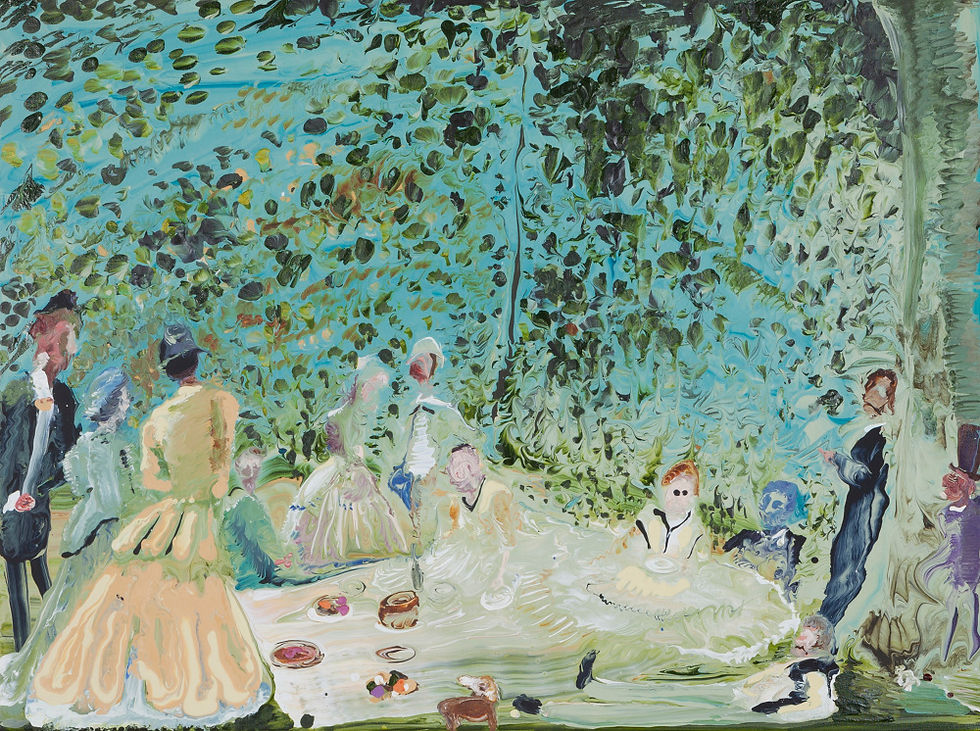
Figure 2
Genieve Figgis - Manet (2018)
The properties of acrylic paint and the mediums that are now readily available make layering and experimenting achievable for me. In What painting is, James Elkins, art historian and art critic says, "Acrylics could only be successful in the twentieth century when painters are more likely to be impatient. In past centuries, acrylic paint would have dried too fast".
Am I impatient because I want to use fast-drying mediums to fuse Hockney and Figgis somehow within my work? The unintentional mixing and experimental outcomes, married with block colour, sweeping gestural marks of undefined forms over beautifully crafted blends of colour and shape. I can use mixed media techniques with acrylic, add blending texture or build over layers. I would like to experiment with pouring the paint and using oil paint over the acrylic surface. I want to investigate and develop, making larger pieces to get 'lost in the process’ influenced by Figgis. The translucent markings make her work intriguing and inspiring for me.
Both Figgis and Hockney have abstract elements in their work, Figgis free and loose, Hockney more controlled. Can I fuse the two?
(Word count 533)
References.
Figure 1.Hockney, D. (1967) ‘A Bigger Splash’. [Acrylic on canvas.] At: https://www.tate.org.uk/art/artworks/hockney-a-bigger-splash-t03254 (Accessed 09/12/2021).
Figure 2.Figgis, G. (2018) Manet. [ Acrylic on canvas 23‘ x 31’] At: https://www.genievefiggis.com/Manet (Accessed 09/12/2021).
Bibliography
Myer, R. (1991) Pages 257-263 The Artist’s Handbook of Materials and Techniques Fifth Addition. Faber and Faber Limited. At: https://en.wikipedia.org/w/index.php?title=The_Artist%27s_Handbook_of_Materials_and_Techniques&oldid=978177660
Figgis, G‘Success is temporal... I feel success only when I am making the work’ (2020)Online article - At: https://www.independent.ie/life/success-is-temporal-i-feel-success-only-when-i-am-making-the-work-39157265.html (Accessed 09/12/2021).
Januszczak, W. (1985) TECHNIQUES OF THE GREAT MASTERS OF ART by Waldemar Januszczak on Mullen Books. Secaucus, NJ Chartwell Books Inc. At: https://www.mullenbooks.com/pages/books/168719/waldemar-januszczak/techniques-of-the-great-masters-of-art?soldItem=true (Accessed 09/12/2021).
Elkins, J. et al. (2000) What Painting Is. Routledge. At: https://www.goodreads.com/en/book/show/165716.What_Painting_Is (Accessed 09/12/2021).


Comments