Agnes Etherington Art Centre, Kingston Ontario, Canada.
- martine75
- Sep 19, 2021
- 5 min read
Updated: Dec 29, 2021
In Kingston, Ontario, Canada, I visited the Agnes Etherington Art Centre in Canada, holding over 17,000 works ranging from the 14th century to the present, which places the gallery among the most extensive galleries in Ontario. It includes paintings, sculptures, and graphics by prominent Canadian artists, European old master paintings, African art and decorative art.
The gallery included Rembrandt's paintings and these were a must for me primarily but, I felt open and reflective of any other art piece that captured my gaze.
It was a well-organised gallery with friendly staff who, gave me several stickers and pamphlets to assist me around the gallery. The items would become part of my sketchbook and a reminder of my trip (below).

The Lii Zoot Tayr Exhibition
Curated by Amy Malbeuf and Jessie Ray Short.
The exhibition showcases artists that ground themselves within and move beyond the earth and solar system to ruminate an outer, inner and deep space.The artists examone their relationships with unseen forces and concepts of spirit and in/visibility.
Everyone has a electromagnetic force around them but it is difficult to perceive. We are bound together by these foreseen if the mechanisms by which they are believed to function are not completely understood.
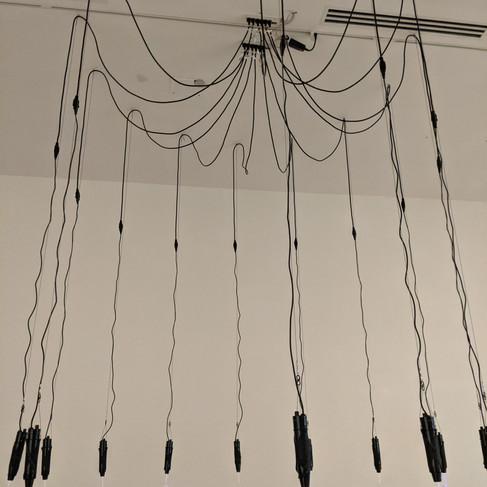
The first room a contemporary installation called Elder Wands. These wands were tactile and intriguing because they burst into life when touched, which was encouraged.
it represents the culmination of a strange series of synchronicities, or coincidences with meaning, combining stories about the Tesla coil, family knowledge,transfer and dreams. There are thirteen violet wands or knowledge keepers that vibrate with possibility. Until you reach out and touch them the circuit is not complete. When touched the circuit becomes complete and makes a shock of insight and so the potential for a narrative or story.
I wasn't sure if I understood the narrative, but certainly, I felt like I had completed the circuit when I touched the wands. My electromagnetic force came to life as a neon spark, and a sound of discharged energy made me jump when I touched the wand! I enjoyed the experience and wondered if the artist was happy that many different people had completed the circuit and, therefore, the story. It made me think about how we are all tied together by life and the earths magnetic force.
Elder Wands
Jessie Ray Short 2021
13 violet wands in embroidered leather holsters.


In the same room was a large hanging knitted metallic square or panel. The same material as I had seen at the Andy Warhol exhibition in Silver Clouds. The material is called mylar, the same plastic film used in birthday balloons or after a shock to retain body heat.
The installation cast a considerable shadow underneath it, and it was intriguing.
Why had the artist used this material to knit her piece? Her mother had knitted for months after her father died, and the artist wants to continue this work. Was the material's mirrored surface a factor? It brings light and weightlessness to your environment and acknowledgement of the material's precarious property. This knitted work represents grief, and trauma passed down from one generation to the next.
I had never thought about the mylar and its connection to light and weightlessness before, and it may be something I could use in the future to represent being airborne.The piece made me think of self reflection, healing and connection to family.
Tiffany Shaw-Collinge
my children,my mother,her mother and their mother,
and thier mother, and their mother,
and their mother.....
2021
Woven reflective mylar.


In the next room, a video plays of trees swaying in the wind. The branches the artist has videoed represent her childhood memories of lying and looking up the wind's negative spaces. The space the wind occupies is unseen, but it is there. The sound the wind makes plays on this tree and has an association of family to the artist. Again the inbetweeners and the unseen part of this piece intrigued me. I made videos and concluded that I felt a feeling of fresh air and freedom. The wind's energy travels from place to place—a communication from tree to tree in my environment.
Suzanne Morrissette
poplar/poplar
2021
Video installation.

My own videos in response to Morrissette.
Next, I walked into a vast room. Within it was a small central space (a purpose-built room) that was intriguing to walk around. What was inside, I wondered?
Portraits populated the four walls of the room. They seemed to be mainly from the 1600s and of sole and lonely subjects (hence the title).

Jacob van Spreeuwen


Jacobus Vrel




Rembrandt van Rijn (attributed)


The Head of a Man with Curly Hair was my favourite. I think it is because of the colour palette of burnt hues and an autumnal glow. The light falls on the man from behind, illuminating his white turban and clothing. The frame is intricate and delicate, and the composition makes me feel a little sad and reflective because of the downward focus and lowered eyes. At first hand, the painting dazzles, if that makes sense? I can see impasto strokes of sweeping texture and form in the clothing. The hair is more broadly defined, and the beard is softer yet still coarse. Although it is small, 24.8 x 19.1 cm, it is captivating.
This painting was a study for two figures, a rabbi and a mohel, in his 1661 painting The Circumcision. When I view this painting, I can see a couple of the study's figures with a familiar stance to The Head of a Man in a Turban. When I view this painting, I can see a couple of the study's figures with a familiar stance to The Head of a Man in a Turban. The exercises we are undertaking in our course are just the same and studies for our assignments or developing works. I am so pleased to have seen these works first-hand to experience the luminosity and warmth of the Great Master.


Remember the room inside the room? Well, I went in, and there was a display of postcard communications from visitors. Visitors could use the postcards provided to send a message and post it to themselves.
Other people had written about their experience at the gallery and placed them on a shelf inside the room. So, under pressure, I wrote 'Hello Friend' (and on the other side a review of the gallery) thinking that every hand that touched the card, to get to me, would say hello back, maybe?
It arrived safely back in Banbury and made me smile and reflect on its journey and how many people had read it. But, it also made me think of how wasteful I had been. The planet was dying, and I had sent a non-essential piece of trivia around the world.
There were many other pieces in the vast exhibition and far too many to reflect on here. However, I have a few more years of study ahead of me, and I can keep them for future development.
Interior room inside the gallery.

Shelf inside the interior room.

My postcard.


Comments