Assignment one - A series of paintings.
- martine75
- Feb 10, 2021
- 9 min read
Updated: Apr 1, 2021
This assignment is designed to help you integrate the techniques and observations you’ve made in the exercises. In the work you produce now you must demonstrate:
• an understanding of different painting media
• an ability to choose the most appropriate painting media and ground for the image you’re making
• evidence of visual editorial decision-making
• experimentation with media and materials
• consideration of the context in which you’ve made the work
• a growing understanding of what interests and motivates you as an artist.
Cut out 20 squares of HP watercolour paper (6x6” or 15x15cm each). Using the materials you enjoyed most during the exercises in Part One, make a painting of one found image on each piece of paper. Once you’ve made them, arrange them in a grid next to one another to form a large painting. Photograph the work. You can return to images you’ve already painted or paint new ones. When you arrange your paintings you might want to photograph them in different sequences and consider the different effect this has. Placing a white sheet, piece of paper or wall behind the paintings will make them look more unified.
Reflect on your paintings in your learning log or blog.
I start to brainstorm and reflect on the exercises.
Are the questions and queries, experiments and outcomes all developing my work?
I reflect more and more. I see the world differently the colours, textures, forms, colours and light reflections. I see objects differently,can they tell stories, do they have memories? What does painting an object say to the viewer what am I trying to get across with my work?
I feel excited and want to make this grid of small square works intriguing.
I make a mind map in my sketchbook of concepts, ideas, narratives and themes.
I watch a video that helps me to populate my sketchbook with the concepts and questions I have floating around in my head.
I read a review of one of the essential reading books from the OCA library resources and decided to order this book;
Godfrey, Tony. Painting Today. Phaidon. Feb. 2010.
The areas in bold caught my eye whilst reading the review. Extending the tradition of Phaidon's landmark Art Today, this lavishly illustrated, oversized publication by Godfrey (Conceptual Art) provides a worldwide survey of contemporary painting from the early 1970s to the present. By means of 16 thematic chapters, the author guides readers through the movements and themes of painting and painters over the last 40 years, examining how people experience painting and discussing hundreds of works by more than 250 artists from 30 countries. Godfrey proves that contrary to what critics and others have said, the medium of painting is alive and thriving in the contemporary art world. He presents a broad range of styles, methods, and materials, including chapters covering the global scene, Western traditions, neo-expressionism, photographic painting, pure abstraction, ambiguous abstraction, figurative painting, painting space, landscape, history painting, still-life painting, installation painting, the Leipzig school, and more. VERDICT Authoritative, challenging, and insightful, this book is nicely presented and well written throughout, with value-added features such as a bibliography, a chronology, and brief artist biographies. For general readers, newcomers, students, scholars, professionals, and everyone in between.--Cheryl Ann Lajos, Free Lib. of Philadelphia
Lajos, Cheryl Ann.
The other book that takes my eye is E. Heartney Art and Today both the books seem to be out of stock in the smaller independent book shops online. I will keep my eyes peeled for them being aware not to 'think' I am grabbing a bargain and ordering in French (I did this with a Phaidon book on the last course!)
I have managed to source two books (secondhand) which I am excited about;
Painting Abstraction, the Art and Today (mentioned above) and Theories and Documents of Contemporary Art.


I have quite a few books to be dipping in and out of now (pictured below a few of my collection so far).

I have an abundance of ideas for the assignment piece, probably too many. It's better to have more than not enough though.
I made a mind map in my A1 sketchbook.


Amongst the concepts for my grid theme were;
The original found images.
Ingredients for a recipe. Influence Marcel Broodthaers
Images of cabin crew 'day in the life' airport etc...
Ways that animals see colour (influence David Attenborough).
Abstract Expressionist artists styles using the found images. Influenced by Matthew Collins Rules of Abstraction.
Countries I have visited (by photographic views or memories)
Film still style of my life- Florist, Cabin Crew, Artist (in training).
Butterflies. Influence Victoria Horken Damien Hirst and Andy Warhol
Famous people portraits I have served/taken care of on an aircraft.
Things that fly.
The same empty glass or item influence Peter Dreher
I decided after some reflection paint the ingredients for a recipe because;
The ingredients are food, so mostly, organic and I like organic lines.
It would be puzzling for the viewer to work out what dish the ingredients make.
The items will encourage me to choose the most appropriate painting media and ground.
I like Marcel Broodthaers' sense of humour in his work (the inspiration for the work).
I also looked at Mimei Thompson work, translucent vegetables with sweeping brush strokes, although mostly in oil paint, they gave me inspiration.
I wasn't a great cook (having no children and being accustomed to years of hotel room service/dining out will do that) but in lockdown I have been practising my culinary arts skills and have perfected this meal. I learnt to make this recipe with a Thai lady some years ago.
The place the dish originates from is somewhere I have many memories of. The colours, smells and essence of the country can be translated.
I made photocopies of images (from the internet) as some of the foods I didn't have in the house. I cropped and mused over the compositions before I finally stuck them into the sketchbook. I experimented in my sketchbook by drawing, painting, reflecting and planning mediums and grounds for each piece. I wrote down feelings and words associated with each ingredient. These would all help with the final outcome.
Which artists have influenced you and how?
I researched a diverse range of artists. Ali Sharma influenced me to make my brush work more evident. Peter Doig has been an influence for his approach and process with thin layers over extended time, leaving pieces to dry and returning to them. The concept was influenced by research on Marcel Broodthaers.
The other artists who have influenced me are;
Gary Hume for his contemporary feel, flat areas of paint and use of line (Slice of lime)
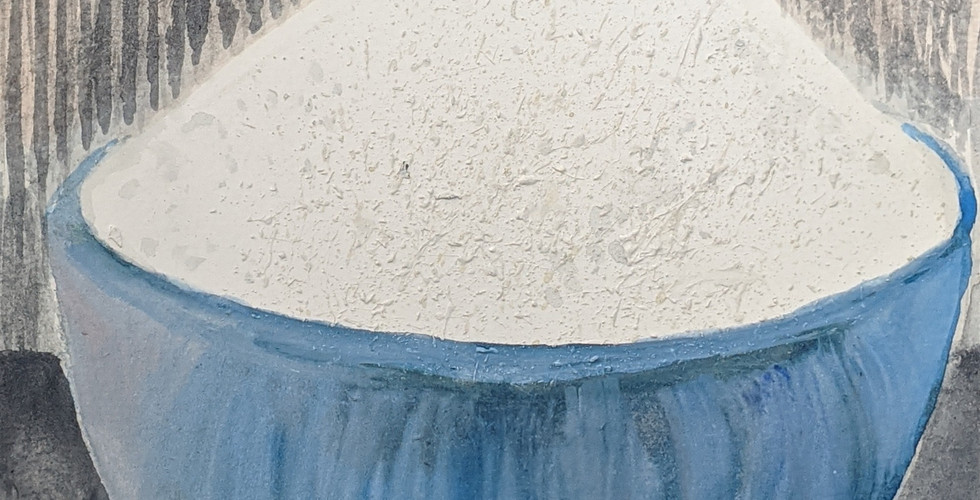
Wayne Thiebaud's Cherry Bowl for its use of muted line and built up tone (Bowl of sugar)
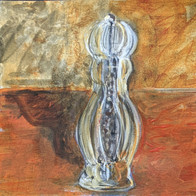
Cecily Brown for her messy application of layered paint (black pepper grinder)
Abstract Expressionism style (shown with use of graphite powder in Cayenne pepper)
Cathy Lomax for her sensitive use of tone (green beans)
Ian Davenport for the shine of acrylic medium using paint tor varnish to enhance the texture of my work (chili and lemongrass)
Giacometti for his use of scratchy line to form outline and form over paint (shallots, coconut milk and sunflower oil).
Jackson Pollock for the use of flicked paint for the texture of sugar (Bowl of sugar)
Susan Hiller for he concept of audience participation in some form ( the audience having to work out what the dish is from the ingredients)
Sketchbook pages.
Each picture has been detailed with sketches, materials and the found image photocopy.
I have used mixed media in all works, ink, acrylic, gouache, gesso, acrylic gloss medium varnish, biro, black felt pen, watercolour pencils, drawing gum and Art graf. Sometimes I have deviated slightly in the written down process of making but generally these entries are correct. I used the upside down image in some cases to gain form and shape.
All supports are HP watercolour paper except green beans which is black sketchbook paper.
(Larger images are on my A1 sketchbook Part One page).


Slider pictures of all the ingredients.






I took a photo of the 20 images in my messy art room (spare bedroom). I have pinned them to the enormous cork board I have installed on the wall. I used this process of swapping and changing the order to assist with the final composition.


When I put the ingredients in a grid without spacing between them they look too muddled/confused.
The ingredients in bowls can't be placed next to each other as they look too similar and this causes imbalance.
The herbs, potatoes and beans also need to be separated for balance as they have very little background in them.
Colour balance is a consideration.
The chillies need to be in separate columns.
I also made a video to showcase some of the textures produced with the varied media.








When I put the ingredients in a grid with a drop shadow effect they look more professional, ordered and balanced.
Final image.
Series title- Recipe ingredients from Bangkok say....
20 images -15cm x 15cm each - mixed media on paper.


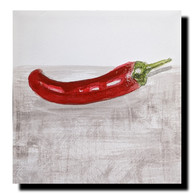


The dish is Thai Green Curry.
Which are the most successful and why?
There a few images that I like more than others, Cayenne pepper is full of energy and life, and I think the mix of the graphite powder and ink splashes brings the correct feel of the seasoning.
The potatoes - earthy and have good depth. The colours are muddy, and the mottled drips and dabs produce the correct surface tension.
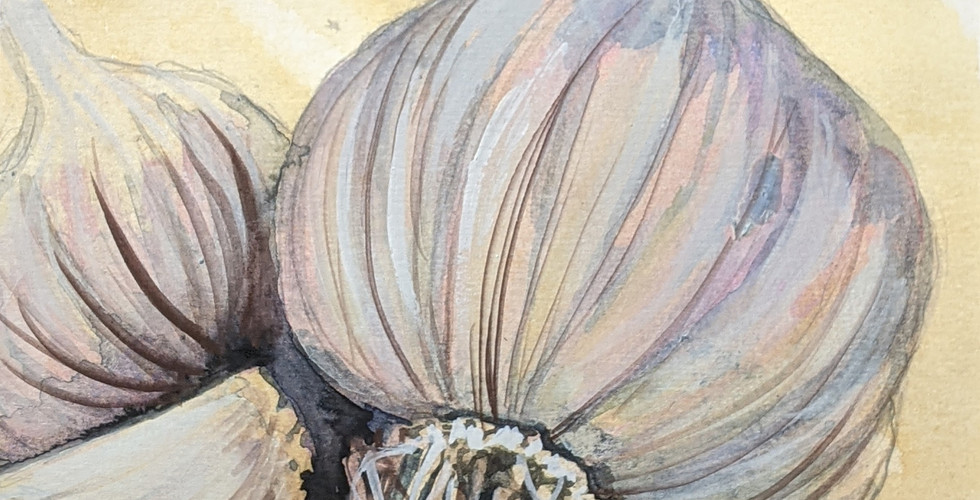
Garlic - I used drawing gum for the texture on the bulb and then built it over the lines with watercolour, giving a 3D appearance.
The green beans (in black and white) are effective and striking. I used Artgraf and water.
The sugar - its texture worked well to depict the grains, and I like this piece's nostalgic feel. I used a small brush and flicked the surface with white acrylic paint.
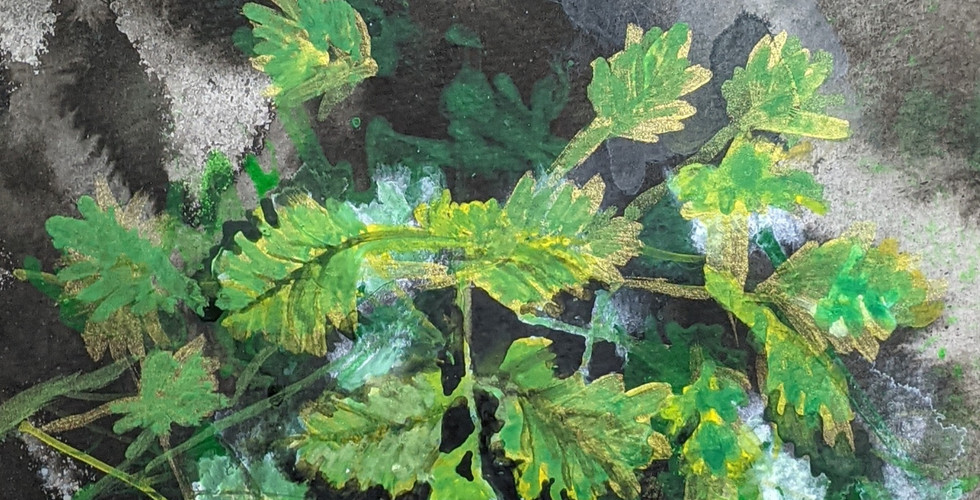
The coriander - has a diffused ink background which compliments the herb.
The chilli- the surface has been coated with glossy acrylic and it shines, which makes it more realistic.
The fish sauce - the rustic background gives it great depth.
Which arrangement worked best, and why?
Colour, shape and visual judgement are created the final arrangement. It seems fitting. It feels right. The ingredients in bowls are separate, the pieces with no background are apart, and the areas of 'colour pop' seem to be visually harmonised.
If you were to develop this work, how would you do it?
The size unifies the paintings, and they create intrigue with the title and the recipe puzzle (I think!) I could develop them by creating several more recipes, a series of series - each recipe from a different culture.
Could I display the images on a lit background somehow, as they do in a restaurant window with menus, maybe?
Could I have the smell of the dish pumped out nearby so whilst you were viewing the work, you could smell the result? I quite like that idea!
Should the work be displayed on a hinged board so you could open it and reveal the dish?
Should the actual food displayed be used to paint the subject? Maybe I have jumped ahead to a forthcoming exercise?
The work could be displayed on a Thai silk background with Thai music playing into headphones activated by sitting on a bench (Susan Hillier's Monument)
What didn't work so well?
The images are small and I am not as confident with this size, mainly because I felt gesturally restricted. Some of the pieces lack energy and feel a little twee i.e. the black pepper grinder and the sunflower oil.
Demonstration of visual skills: Materials, techniques, observational skills, visual awareness, design and compositional skills.
My sketchbook is full of investigations. I made in depth experiments with new mixes of media and learnt techniques i.e. working form an inverted image.
I am able to visually critique my composition skills in a more discerning manner with each module.
I am progressing with technical ability with painting media e.g. working over varnish and shiny surfaces and using layered watercolour techniques.
I reflect, research, investigate subjects and artists fully before I start a piece.
I have created intrigue in the concept of my work and I continue to broaden my knowledge and skill set within these new concepts.
Quality of outcome: Content, application of knowledge, presentation of work in a coherent manner, discernment, conceptualisation of thoughts, communication of ideas.
I am confident that the title of my series 'Recipe ingredients from Bangkok say...' introduces the viewer to the 20 images, and they are intrigued enough to investigate the dish displayed. I have used techniques to showcase the surfaces of the ingredients and listed development concepts to enhance my work. I maintain my confidence and enthusiasm to improve my capabilities and am willing to reflect more before I produce work that I am not entirely content with. I understand that exploring not only artists but thought processes, curators, textures, art history and outside influences can direct and shape my work. I am beginning to understand the concepts artists use to underpin thier work is sometimes actually 'the work'.
Demonstration of creativity: Imagination, experimentation, invention, development of a personal voice.
My artistic expression, imagination and creative writing continue to improve with the links between my work and the artists who influenced it.
I have experimented with varnish, glaze and watered/thinned my paint in under layers.
I have varied the pressures, dilution, consistency and direction of my paint.
I understand that the connection to the meaning of my work and taking risks to make narratives that create intrigue, will eventually bring me to reveal my personal voice.
I have a determination to improve. I continue to add 'strings to my bow' by collating within my sketchbook and learning new techniques to find my unique personal voice.
Context: Reflection, research, critical thinking (learning logs and essay).
When I apply the knowledge, research, processes and concepts I want find a connection with artists and their processes/ways of making. With enthusiasm, I am very committed to my goal and developing my skills within the guidelines. I have documented and identified these connections in my research and reading pages and applied them within my work. My sketchbooks and learning logs are an explaitory journey (visual and written) that influence my work, and I acknowledge that this will ultimately bring my critical understanding of my practice.
References
Lajos, Cheryl Ann. "Godfrey, Tony. Painting Today." Library Journal, vol. 135, no. 1, Jan. 2010, p. 104. Gale Academic OneFile, link.gale.com/apps/doc/A217510784/AONE?u=ucca&sid=AONE&xid=4cd7d02a. Accessed 8 Mar. 2021.


Comments