Assignment Two - Collection painting.
- martine75
- Apr 28, 2021
- 14 min read
Updated: Jun 1, 2021
Revisit a medium you’ve enjoyed using. Lay your collection on a black or dark-coloured surface. Shine a dramatic light on your chosen collection and, working on an A1 or A2 format, make a painting which explores your chosen media and brings together your experiments with line and tone.
Reflect on your collection painting in your learning log.
How successful is it and why?
If you were to develop this work, how would you do it?
Which artists have influenced you and how?
Reflect on the ways you’d like to develop your work and the essence of what you hope to communicate.
I have been researching and contextualising sources for Assignment Two.
I want to keep in mind;
Who is the collections intended audience?
What is the artworks intended purpose?
What is happening whilst the collection is being created?
Which artists influenced the collection and why?
I am becoming overwhelmed with knowledge and want to inform my practice with my research, critical thinking, academic reading and reflection.
I asked other OCA students how they do this, one student recommended a mind map.
I have used mind maps before for my assignment pieces but never for reflection on my research. This helped me declutter my mind if that makes sense?
Writing ideas down in a notebook, that I have by my bed and at my side, in my handbag or in the car, is a great aid for documenting my thoughts.
When I paint I write notes and when I read, I make notes.
I dream about the work I am undertaking and sometimes dreaming helps me decide on what or how I want to paint. Is this normal?

Found objects mind map

I have tried to link artists/sculptures/poets/composers/art movements etc with theories relating to collections/found objects and the readymade.
Seeing my thoughts written down and collected in this mind map helps me to focus more.
I see parts that I can use to underpin both my practice and hopefully use to develop my skills.
The mind map is a web of knowledge and I can see that it is infinite. A limitless network of knowledge that I can choose to select parts that mean something to me.
I want to push myself development further by being expressive and meaningful within my work.
I am becoming more aware of what makes an artwork and how to deconstruct it to really get to grips with all the elements. Art has developed over many years and is ever changing.
I know I can't just pick up a book of art and read the entire history, this takes time to take in, absorbing then selecting what I think I might take forward and develop.
I have highlighted the areas that interest me on my mind map.


What have I learnt so far
When I look over all the experiments in unusual materials, line, tone, painted surfaces, painting on metal and 3D work I appreciate I such a diverse range of media to choose from.
The challenge is knowing how to apply and understand the media in a suitable way for the composition. Choosing the subject matter with respect for the materials is fundamental.
Each support has its own disadvantages/advantages and this applies to the medium you use on them. For me the most important knowledge has come from those experiments and findings.
I am confident with ink and wash/tonal staining.
I feel that I need to be more expressive and gestural with my paint and working on a larger scale gives me this freedom. I also realise that this painterly approach is in the next parts of the course.
I want to explore with open acrylics more deeply as I had in my Practice of Painting module. I feel like this is an area where I want to develop and (hopefully) shine. Also this challenges me.
Combining experiments in inks, thinning my acrylic paint in washes and layers, working reflectively with more meaning to my work I feel will bring the energy back to my pieces that I think it lacks at the moment.
Reviewing my work and experiments will assist my development.
The below pieces are selected because I believe they are the strongest of my experiments.


What do I see when the images are together?
They are quite dark and earthy in tones, hues and values.
Texture or surface plays a large part, be it crackles, scissor blades or texture created by line.
They all feel flat and without life in them. Is this because of the colour pallette choices?
The positives are that the compositions seem to have more depth of field and a tactility is present.
I can't say that my collections have no meaning because they do. Some more than others.
The shoes have a sense of place to me.
The ink bottles are bottles that are everyday items and I create art with them.
The wires are tangled and how we feel at the moment in a covid world.
The seashells also evoke a sense of place.
The scissors have symbolic meanings of emotional repair/restoration or seperation of life.
The jewelry evokes a hanging or pulling down feeling.
The mugs are from all over the world and connected to geography (sense of place again).


Collection Painting
The brief says;
Shine a dramatic light on your chosen collection and, working on an A1 or A2 format, make a painting which explores your chosen media and brings together your experiments with line and tone.
Format - this to me means I can make some part of the painting 3D and therefore include Painting on a 3D surface into my assignment, as long as my format is A1/A2.
Explore your chosen media - I can layer, wash, add glazes and explore open acrylics in my assignment piece.
Dramatic light- a torch would create a dramatic light setting.
I have a few ideas for the collection. I want to really gain a sense of place in this piece as it is one of the below highlighted areas from my mindmap.
Memory Association in Place Making: Understanding an Urban Space by Qazi Azizul Mowla.
We experience our present world in a context which is causally connected with past events and objects, and hence with reference to events and objects which we are not experiencing when we are experiencing the present. Area between and within an object is space
which becomes place when occupied by some person, thing or any other attribute. The
remembrance of an event or events is a valuable identifier of space. Our personal histories and identities are interwoven with space and places. We attribute to places a personal memory-tagging which marks them in our mind. In this way we might say that we need to remember in order to have an identity and sense of place.
Why do we need a sense of place?
Using found objects which resonate with the spaces I have visited or experienced. Is it memory I am interested in or the nostalgia, the smells, climate and overall feel of a place?
Psychogeography describes the effect of a geographical location on the emotions and behaviour of individuals but is this linked to objects or just wanderings in a specific place? Am I jumping ahead to the next part of the course here?
Could I use objects from my career as Cabin Crew as they have a sense of place and meaning from my experiences?
I was enthusiastic to delve into the loft and find my plastic storage box full of cabin crew memories. Why hadn't I thought of this earlier?

Box of memories from my Cabin Crew career


This reminded me of Kurt Schwitters collages, because of the found papers and objects inside the box ;-
Crew labels from my suitcase
Receipts from duty free purchases
My vaccination book
Customs and border declaration forms
Customs seals
My gloves and hat
My name badge
A Sindy doll of a British Airways stewardess with blonde hair and red lipstick (so far away from my 'look' as a crew member!)
My safety equipment and procedures books
Aircraft diagrams
A salt and pepper sachet from the economy cabin (found inside my pinafore pocket. (Always good to have available for a customer who would no doubt ask as you walked by).
Fliers and crew briefing sheets from various countries.
A model 747 aircraft.
There are so many memories, too many in fact. I could make a series of paintings/collages with the amount of collected and archived items here. I was happy to continue with this concept and I think that if I chose the items with care the narrative will be of interest to the viewer.
Who is the collections intended audience?
People always asked me about my career, so I think that there is enough of an interest for the viewer and I can paint through my experience of these objects.
What is the artworks intended purpose?
I want the piece to be nostalgic and informative from the objects I choose. I want the audience to be intrigued about 'crew life'.
What is happening whilst the collection is being created?
The aircraft I flew on are currently mostly grounded due to the global pandemic. One the aircraft the 747 (Jumbo Jet) has been permanently retired. I think this concept has meaning and will have in the future.
Which artists will influence the collection and why?
I would like to use the Merz collage concept of Kurt Schwitters as part of the work because he used a surface for the accumulation of matter and memory.
The difference being that some of the materials I will use do have meaning because they are my memories shaped and formed on the support.
I photographed some of the items with a dramatic light (which I had to do at night) with a torch).


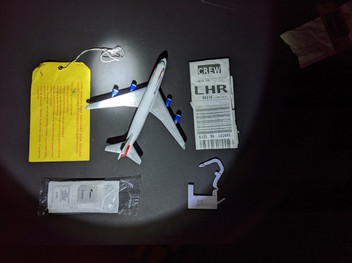


I put the images through digital filters on my phone, to see the tone, value and shadows.


The shadow of the aircraft excites me, the polarized image show the highlights and mid tones. I think that the image may appear quite flat though?
The items are;-
A model 747 aircraft
A name badge
Two baggage tags one a crew label (yellow) and one a barcoded generic tag. Crew bags had to have these yellow tags so they could be easily identified by the baggage handlers at any airport. When you have been at work for sometimes over 20 hours you don't need to be waiting hours for your luggage with sometimes a quick 12 hour turnaround. The crew baggage tag had been to Boston (BOS), Lagos (LOS), Hyderabad (HYD) and Singapore (SIN). The generic tag was from my last ever flight to New York (JFK).
An economy salt and pepper sachet.
A lilac plastic numbered custom seal (used to seal alcohol or duty free bars when the aircraft was on the ground between crew handovers).
My uniform gloves.
Sindy.
On the reverse of the Sindy box it says,


I laughed out loud as the exhaustion and jetlag hasn't affected Sindy at all.
Perfectly polished and fit to fly!
I needed to play in my sketch book with some ideas and techniques.
Below is my initial sketch.

Then my thought process took me to the work of Arman and his curation of objects in shelving units and boxes/cupboards.
Why?
Because the image looked so flat again, my tutor's feedback speaking to me from my subconscious.

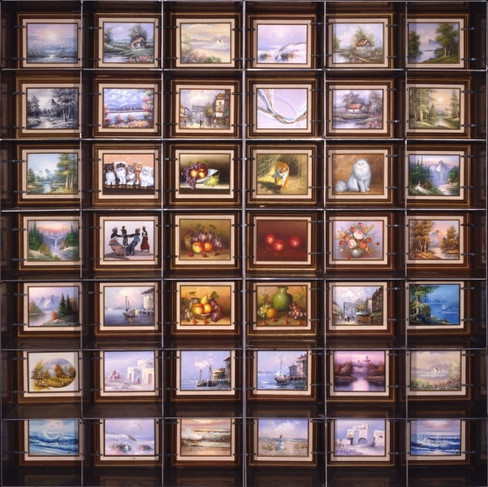


Figures 1 & 2
I didn't have a shelving unit but I had several packaging and perfume boxes that I had kept.
I made a shadow box with 3 place mats (the first image in the gallery below) and photographed each piece, thinking I would paint the objects and then put each painting inside the boxes.
Process of finding my composition.


I placed the digital images in a collage and then decided that the best option was to put the objects inside the boxes and then photograph them.
My thought process concluded that I could paint the photograph of the objects in the boxes.

Should I stick the boxes onto an A1 board?
Should I stack the boxes?
I stacked the boxes and applied Blue Tack to place the objects inside the boxes.
Below is the first image where I am starting to get a composition that I feel will work.

What do I need to do now?
Paint the boxes black as the brief states a dark background.
Dramatically light the little boxes of airline memories.
Arrange them so they are aesthetically pleasing.
Photograph them.
Decide where I want collage areas to be.
Decide on my medium.
I have a checklist that I refer to ;
Prepare with WORDS as well as images. Nostalgic, Airline, Crew, Compartments, Overhead Lockers, Collections, Travelled, Sense of Place, Documentation, Customs, Baggage, Routines, Safety Culture.
FEELINGS and EXPRESSION associated with the piece.
Exhaustion Pride Excitement of travel Routines Memories of places Retirement of iconic aircraft Grounded planes because of the pandemic.
VIEW POINT ANGLE of the scene.
Boxes shadows dramatic lighting
Colours that connect with the emotion or person.
Red white and navy blue? (not sure) Black and white for tonal impact and nostalgic/ still calm grounded feeling?
Pops of fluorescent colour edging for a contemporary feel?
The story or narrative (if one) the interest of the piece.
Make the art interesting to me, enjoying perfecting and creating an EXCITING PIECE FOR ME.
Cabin crew memorabilia, Vaccination records, grounded planes in a pandemic, baggage tags that have actually travelled on my case, link to the customer with salt and pepper.
Sindy maybe just a close up of her face?
1 COMPOSITION IDEA FOR STRONG DESIGN I think so
2 SIMPLIFY WiTH THUMBNAILS/ NOTANS I have mused over this in my sketchbook
3 VALUES SHAPES I have mused over this in my sketchbook
4 BALANCE AND HARMONY COUNTERBALANCE
FOCAL POINT COLOUR LIGHT I have mused over this in my sketchbook
5 VISUAL UNITY RHYTHM /DIRECT EYE OF VIEWER/ REPETITION IN WORK
The light and shadow cause a repetition on line around the work and the eye should be drawn to the brightest lit area.
6 DEPTH Each box creates depth and the boxes will have a background.
7 RULE OF THIRDS The background will create a break of one third and the box sections will break up the rest of the piece.
8 GOLDEN RATIO This comes from the vaccine book as a focal (brightly lit area)
9 EXPERIMENTAL work in my SKETCHBOOK for the MEDIUMS USED FORMAT /SUPPORT
I have mused over this in my sketchbook
10 INFLUENCE of ARTISTS Several - Kurt Schwitters, Mark Dion, Arman and Fred Wilson.
Sketchbook/ loose leaf musings playing with tones glazes and composition.


Objects lit with a torch


Process
Materials
A1 mount board (black)
Open acrylics Raw umber / Cad Red / Cad Yellow / Cer Blue / Titan White
Paperwork/fliers collected whilst travelling.
I chose the board over paper because it was more robust and the surface smooth for the open acrylics application.
I swept gesso and acrylic over the base in large expressive movements for an underlying base layer.
I sketched in the compartments with an Artgraf pastel as it had a straight edge and it was easily painted over.


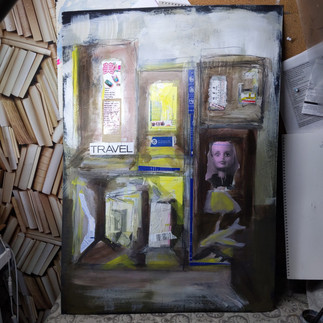


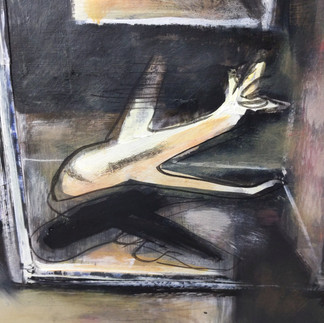


I had the basics in place. I glued on a photocopy of Sindy's face, customs documentation and fliers from various countries to add interest, ready to be layered over with diluted paint.
I arrived at the stage below., lost and not sure where to go.
The light wasn't strong enough, objects weren't refined enough. It needed details.

Several sessions later, using glazes and retarder to blend and create light I felt I was beginning to get to a more comfortable place. With the aid of my boyfriends torch skills, I decided that the light needed to be more dramatic rather like a museum at night and the objects being lit whilst the security guard did his rounds.
I took a picture of the torch light on my picture and worked from that.

I added several scumbled glazes to the background in purple to compliment the yellow light.
I used small detailed lines to highlight areas and packaging.
The torch light has been built up over days of glazes in green, yellow and white.

Result

Cabinet of Crew- iosities
A1 open acrylics on board.
What has worked well?
The use of the light and shadow and my exploration of the open acrylics shows a fair understanding of the media.
Glazes and layers have been used to create different tensions within areas for example more blended for the torch light and more scumbled for the background.
The concept, I liked it, but have I achieved what I wanted to? The outcome is more eerie than nostalgic. It has a scary feel which is quite unsettling, the fact that a painting causes an emotion is encouraging.
Have I included enough of my exercise work in this piece?
All the objects have are 3D, some more technically accurate than others. I have used fine line and achieved a fair likeness in my opinion.
What hasn't worked so well?
If I'm honest the whole thing!
I'm not really a fan of this piece, it has a horror film or a night at the museum vibe.
Was this because of my research and the uncanny being in my subconscious or because the brief had asked for dramatic lighting?
I found open acrylics hard to achieve the same level of detailed line as I had with more water based diffusible materials like ink, they behave more like oils, but I like the creamy textures and buttery feel when blending tones.
Should I have diluted my paint more at the offset and been more expressive? This was a difficult brief to achieve for me and I wasn't confident that I hadn't tightened up again.
Had the use of the photocopied Sindy been a huge mistake? Yes, possibly but I had taken that risk now, without redoing the whole piece I think I have learnt to be more selective with mixed media. I had in fact covered over most of the glued on papers and collaged areas. I did quite like the look of the ruffled and painted over areas, as these had caused a vintage aged surface. I may be able to use this texture in the future.
I asked an ex-cabin crew member to look at the art work and she knew what every single item was, so there is a positive.
I found open acrylics hard to achieve the same level of detailed line as I had with more water based diffusible materials like ink.
How successful is it and why?
I don't feel my line work is strong enough in this piece, blends and tone are present but use of line and expression is lacking. The name badge (under the yellow tag) is pleasing with the light and shadow across the surface. The small detailed work on the tags and book although time consuming brings variation.
I find myself disturbed, not by the objects but by Sindy, the colour scheme and the composition. Does it evoke a Tim Burton film still or a German Expressionism style?
If you were to develop this work, how would you do it?
I would have liked to develop the idea of memorabilia from my career somehow. I think it has interest and appeal. I feel familiar with the objects and they have meaning to me. Maybe putting them in different contexts or making more of a still life composition (see below).
Should I redo the piece with this composition in inks? Would it have more appeal in a brighter more colourful palette? Would this then be reflective of the pandemic and my nostalgia?


Which artists have influenced you and how?
Arman for the composition. Kurt Schwitters for the inclusion of materials and Mark Dion for the title of my work and his collection Digging the Thames.
I suppose Cecily Brown had underpinned my technique, when I created the background, with large sweeps of acrylic. Fred Wilson played a large part in why I chose the objects and how I placed them.
Reflect on the ways you’d like to develop your work and the essence of what you hope to communicate.
I mentioned earlier that I have retained/collected a substantial amount of objects and material from my career, these could be developed or incorporated into artworks.
The sense of place aspect holds my attention and is something that I would like to develop, by that I mean either from memory or actual objects. I have a wealth of travel memories/objects/mixed media material why not use them?
Should I have focused more on the grounded aircraft at the time of a global pandemic, and how I could of curated my objects differently?
Overall reflection.
I am enthusiastic for the next part of the course, staying positive and with a considered approach to move forward. I have felt a little stifled by the subjects in this part and am not feeling my energy or expression coming through into my work.
I know that understanding the media is the key and focusing on the basics is all contributing and guiding my process.
I think was carried away with the process, trying to understand the media, research and I have overthought the assignment piece , AGAIN!
I haven't acted on my feedback, I haven't experimented enough maybe?
I am excited to receive the feedback for this part but am quite confident that my outcomes haven't been as successful as I would like. I much prefer a fluid, expressive brush stroke and semi abstract compositions. In the past fluid compositions have had the best outcomes i.e landscapes and seascapes.
I will continue to experiment, learn and find my way, discovering and researching and enjoying every moment. Developing my practice is the key to success and not everything will work out for me. Sometimes the best outcomes come from not planning at all.
I find it difficult to evaluate my own work but I am slowly growing in confidence in this area. I also need to engage more deeply in other artists work to underpin my own work, I know this, so developing my academic learning skill set to enable my progression is something I need to focus on in the future. I have made an effort to read more and use more resources for my research in this part of the course.
References
Figures 1 and 2 Accumulations in a Box Pinacoteca, 1993 & Summer time. Available at: http://www.armanstudio.com/artworks/accumulations-in-a-box?view=slider (Accessed: May 2021).


Comments