Exercise 1.3 Quick and focused.
- martine75
- Feb 10, 2021
- 3 min read
Updated: Apr 22, 2021
Use A3 paper for this exercise; cartridge is fine but HP watercolour paper is even better. Select five of your found images. Now use your brush as you would a pencil. A long thin brush is useful for this. Get a plate or palette and have any combination of water-based paint and a large vessel of water at the ready. Now, looking at the images and NOT the paper, paint what you see. Time yourself for one minute. Overlap the images as you go and work quickly. Do this three times on three different pieces of paper. Make brief notes on the outcomes.
I think this is similar to blind contour drawing.
I found the below article by Elli Hill of interest;
I had tried the exercise of drawing ambient sounds with my eyes closed whilst on a study trip to Lisbon. Michelle Whiting (one of the OCA tutors on the trip) expanded my skill set and learning with this exercise.
I think that not looking at the page brings freedom, a different approach and a loose outcome. Below are the pages of that sketchbook and the words I wrote about my environment at that time.


I think we are delving into neuroscientist Roger W. Sperry's theory which led to Betty Edwards' "Drawing on the Right Side of the Brain" book.
I used the following five abstracted found images.
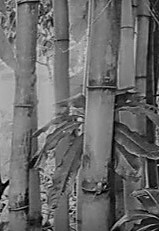
Sunflower, jet engine, bamboo, jellyfish and butterfly wing.




I printed off the five images and arranged them on my sketchbook page. I mixed variations of diluted gouache and watercolour and used 3 different brushes for each piece.
The support for all the work is A3 Khadi paper.
Rigger synthetic brush

It was difficult to start and the minute timer was making me rush!
The rigger brush doesn't hold much paint and so some of the marks are 'dry'.
I can see musical notes and hear classical music when I look at this piece. Although I usually listen to music whilst I paint, I noted that it was silent whilst I painted this piece. Was I subconsciously painting the absent music?
Angled dagger synthetic

This was my favourite piece as it has more variety of line and tone. I would develop this further by blocking in certain areas with some colour, to highlight the geometric shapes.
I was enjoying the freedom of this exercise, even if the time frames of a minute were a challenge for me.
Mop brush

Too much fluid gouache and watercolour mix causes the brush marks to meld together.
The brush held a lot more water and pigment than the previous exercises.
This pieces brings a totally different feel of heavy, dark and a scribbled mass of lines. I feel entangled like I am amongst the branches, in a wood or can't break free.
When I really look closely at the diffusion, it reminds me of a subtle tie dye effect ( I used to tie dye my clothes when I was a teenager). I like this but I want to create a Pollock style of dripped marks over it in a neon maybe? I want to sweep gloss bands of varnish over the matt areas. I know I could develop this and that this is a great way to create a base for a painting.
What have I learnt?
My eyes were looking and my hand was creating. Other ways to change my process would be to cover my work with a newspaper for instance, view the subject through a mirror or draw with my non dominant hand.
These processes all contribute to editing an image. I found it stimulating for an exercise and opening up new techniques. This base layer can be the underlayer of my work, the starting point or parts blocked out to crete tension maybe?


Comments