Exercise 4.1 Painting a series of circular paintings.
- martine75
- Jul 21, 2021
- 6 min read
Updated: Nov 15, 2021
Aim to collect the following surfaces to paint on: five circles, three ovals, three paper plates. Make a circular viewfinder.
You can either:
• Take a photograph of something inside your house and place the viewfinder on top of the image.
OR
• Make a card viewfinder that you can hold up to an area you want to paint in your house and work from this. Make a series of five circular paintings using thinned-down paint. You could use watercolour, gouache, acrylic or turps-diluted oil paint for this. The subject of your painting can be any of the following:
• the interior of a cupboard
• a shelf or mantelpiece
• the interior of a drawer or wardrobe
• a ceiling light
• a pile of post
• a dishcloth or flannel, in situ
• an unmade bed
• a bedside cupboard
• shoes, wherever they are kept
• a wash basket or pile of clothes.
Now take photographs of your paintings and leave them to dry for Exercise 4.4.
I took a few photographs on my mobile phone and used a circle filter to make them into tondos.
The plant on the shelf is artificial. When I worked as cabin crew, I couldn't have plants in the house as I was often away for as long as 10 days. When I started living with my partner he would forget about watering the plants and they would die.
I the below image, I like the shadow on the wall by the plant and the shelf shape enclosed in the circle. The shelf reminded me of Ilya Bolotowsky or Piet Mondrian with the linear and geometric forms.
The travel and Spanish language books I have collected over the years. The composition, when cropped, has interesting perspectives and shapes encircled by the tondo.


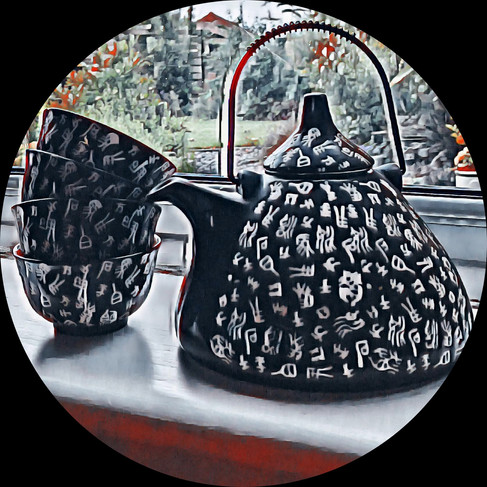
I bought the Japanese teapot in a small shop in Narita, Japan, whilst on a work trip. I tried several compositions, eventually inspired by Tori Day's Beryl. I have positioned the teapot slightly, peeking over the windowsill, with an upward view, and the image is both polarized and put through a filter on my phone.




The ceiling light has a slightly different meaning to me as an ex- cabin crew member.
Waking up in different hotels and dealing with time zones makes you forget where you are sometimes. One of the first clues, as to where you are currently, is the ceiling light. I knew if I had insomnia or woke up to see my ceiling light, I was safe and at home.
Being in a five-star hotel bubble is seen as safe, but sometimes you are in a volatile country or unable to go out of the hotel at all for safety reasons. You, therefore, are on edge, if that makes sense, even whilst you sleep, making the jet lag worse. Being an in charge crew member also means you are responsible for the crew and could get called at any time day or night with queries or updates concerning the return flight or safety issues in that country. That ceiling light in my bedroom was an absolute pleasure to see when I opened my weary eyes.


I have two sets of hair straighteners because when you travel a lot, you don't unpack your case time and again. Many of my hair appliances have been bought whilst away and have the plug of the country I acquired them in. On reflection, the composition and narrative aren't that compelling!
The alarm clock in the open drawer is no typical alarm clock. Instead, it is an alarm clock for the deaf. Why do you ask? When cabin crew take bunked horizontal rest on an aircraft (for longer flights), up to six people rest or sleep in a tiny bunk bedded area close to each other. It's an area that the public never see and is usually above the cabin and accessed by a steep ladder staircase behind a door with a placard saying CREW ONLY.
I always needed to compose myself before going back on duty and set the alarm to wake up early. How could I wake up without waking all the other crew? The alarm clock pinned to my chest pulsed and shook without sound. It is now redundant, but it reminds me of the jetlagged and exhausted feelings of waking in the dark on a jet aircraft each time I look at it.


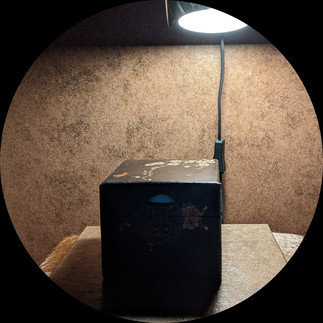
Bedside tables weren't that exciting for me, and the composition was dull for me. I do, however, like the shadow from the box that I bought a market in Shanghai. Could I turn dullness into intrigue? Could I manipulate the colours in the light somehow?



The unmade bed is something I have become accustomed to, there is no housekeeping at my house; it's me who makes the bed! Similar to my explanation for the ceiling light, sleeping in many different mattresses in many other places makes your bed a sanctuary, the pillows you love, and the cosy familiarity of your sheets.


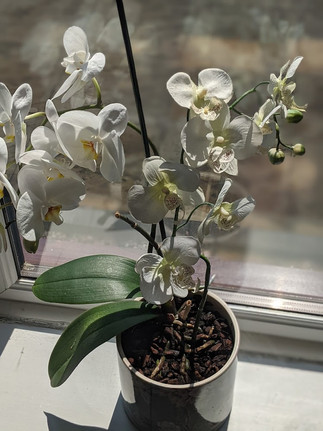
I have photographed more of the artificial flora in my house on windowsills, floors or shelves. I arranged them so that they are more aesthetically pleasing with interest in shadow or composition. For example, I love orchids (probably from my visits to Asia and being an ex-florist). I would buy huge boxes of varied orchids on work trips and bring them home as they would for last weeks.



The open window is an essential subject for me. Hotel rooms, especially those with over seventy floors, do not allow the occupant to open the window (for obvious safety reasons). An aircraft is contained sealed and full of recycled air. Being able to breathe fresh air and open the window is a treat and still makes me feel free. Air conditioning of any sort dries your skin. Being contained regularly makes you appreciate the natural breeze.



I know from looking at the work of Tori Day, that making some of my circle or oval surfaces 'irregular', using gesso and scoring into it for example, will enhance the way in which my chosen objects will be communicated.
The objects aren't actually the prime focus, by that I mean, the way I apply the paint and why I have painted them, has as much of a part to play as the actual image does. The meaning is important and how I communicate my narrative also the viewpoint and composition need thought and contemplation.
In this video, I note that Caravaggio used a scoring technique and then umber earth tones for his underpainting. This underpainting gave a warm undertone to his figures. However, Caravaggio did not always allow this base layer to be dry and mixed the overpainting into it.
I prepared the cardboard, cake board, paper bags and paper and aluminium plates. I added gesso, collage and a ground to some.


My research told me that underpainting is the primary dilute layer of paint applied to the canvas and it functions as a base for other layers of paint. It is a foundation for painting and I can start my painting off building in some contrast and tonal values.
Points to note are;
Blue toned underpainting can give a cold feeling.
Yellow toned underpainting is great for underlying warmth.
Purples are good or for making shadows.
I used the three photographs below.


I used a variety of brushes filbert, square and flat to apply;
diluted purple/ blue gouache for the plant on watercolour paper. The shadowed areas mostly.
diluted yellow and monochrome acrylic for the flowers on khadi paper. The light was warmth and the teal green a more contemporary base for the darker shadows and values.
diluted sky blue ink and charcoal, smeared gesso on two pieces of watercolour paper stuck together. Later I added darker values and some pink, just for an experiment really.


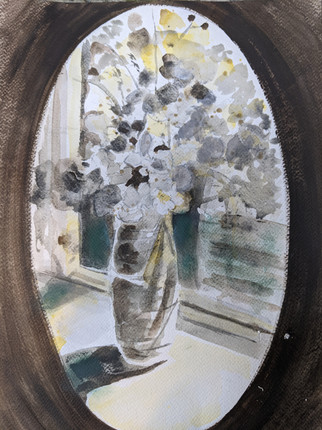


I wasn't really sure if I needed to add more paint?
But I left them as I knew I would be adding more in the ongoing exercises.
All varied using
loose ink sprayed with water
diluted acrylic
diluted oil
watercolour
gouache
I have three ovals;


I have several circles;


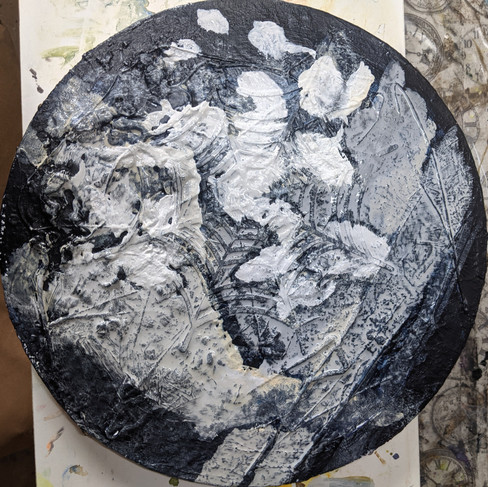


And several paper/aluminium plates;


I was excited to start painting. Artists from my research were in my subconscious, along with my tutor feedback.
What did I learn?
I learnt that the underpainting and the choice I make greatly affect the painting, for example the colour choice or texture can affect the overlayers application.
The colour can shine or 'peep' through to warm or cool the over layers.
I could have made more in depth marks towards the painting that would have informed me that the composition was too small or incorrect.
The underpainting is the base to begin my painting, my contrast and tonal values could have been more defined in most cases.
Mostly the underpainting is a springboard to set the values and tones correctly it can be left raw or painted over for differing effects.
The underpainting is fundamental to the textures that can be underlying in the work and seen through layers.
Developing and forward thinking for my work in the underpainting is something I can work on in a plan for my pieces.


Comments