Tutor formative feedback Part 1 & my reflection.
- martine75
- Feb 10, 2021
- 7 min read
Updated: Apr 22, 2021
My tutors feedback is in black text my reflection is in orange.
Overall feedback
Thank you for submitting Part One for UPM and well done for working methodically through the first part of this course.
Painting thin and small
You have managed to produce a range of simple outcomes that explore the materiality of paint on a small scale. Many of the image sources have great compositional and tonal value. Try to be more aware of negative and positive space when copying images, however loosely and try to mid your colours to play around with the depth of field wherever you can as some of the images are a little flat in places. Where you have considered tonal value more, such as in painting no.9, 14 and 16 the images appear much more considered and less fleeting, however you have managed to present a loose application of paint throughout, so well done for not getting too controlling in terms of paint application.
Good reflection at the end, well done.


I reflected on the images mentioned, each do have more considered tonal values and I can work on this feedback by developing my tonal approach going forward with varied materials.
Look at what you see and not what you imagine
This exercise is designed for you to portray what you see, rather than allowing your brain to ‘make up’ elements that turn out to be incorrect. Looking at shapes is easier than looking at things the right way up, so your response is completely normal. The outcome for this exercise is intriguing and arguably not what you would have produced had it been looked at the right way around, so this technique is to be encouraged as you move forward when copying further images. Lots learnt here, so remember to build on what you have learnt as you move forward.
I wrote;
What did I learn?
Being out of my comfort zone brings unexpected but pleasing results. Time pressure/upside down painting is a great way to focus on the essence of an image, the shapes and forms of a piece. I feel that my work is better when I don't concentrate so much and use my gut or instinct to paint the forms. I like the expression and mark making in the first piece with the diffusion and bleeding of the fluid paint. I am understanding the media more and how I can manipulate the paint to make the marks that excite me.
This seems to be a process/ technique that has been encouraged. I look forward to finding new ways for its development.
Exercise black and white
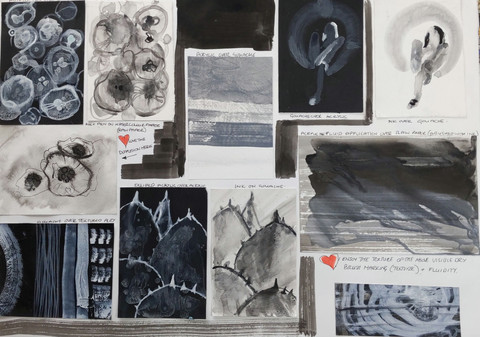
It has been great to see you write a little more about different paints here as well as consider the cropped image when looking at the more experimental works completed so far. Your sketchbook experiments have been edited for presentation. Editing is an important factor when making work, so don’t be frightened to take things away as well as add. Consider further around how to curate. Often less is more and gives space around the painting or drawing in order for the eye to focus. Be wary of when you are ‘decorating’ and if it has a purpose’ I am thinking here whilst looking at your curated work in your sketchbook. Do the scraped lines on the page add or detract from the overall image?
The macro and micro approach to looking closely at something gives the audience an opportunity to touch lightly on what is being presented. Is this deliberately done, or something that you are aware of when looking at the work again overall?
Very good reflections after the exercises, well done.
Do the scraped lines on the page add or detract from the overall image?
They absolutely detract, yes!
When I view the sketchbook pages with 'fresh eyes' I am disappointed with myself. Why have I muddled the pages and made what I can only describe as a jumbled mess? These monochrome images could have been striking, IF only, I had edited the pages in a coherent but creative way. I have tried to remove one image but I have been overzealous with the glue and therefore they will remain a mess and a reminder.
The macro and micro approach to looking closely at something gives the audience an opportunity to touch lightly on what is being presented. Is this deliberately done, or something that you are aware of when looking at the work again overall?
I feel I am being asked to clarify in more detail why I have chosen a micro/macro approach.
I wrote in my reflections;
My abstraction for better composition of the images brings more independence to my work.
The Tate describes abstraction as when an artist has either ‘removed (abstracted) elements from an object to create a more simplified form’ or produced something which ‘has no source at all in external reality’.
So, I have used the incorrect term to explain my process. My micro/macro approach was a deliberate choice for some of the images. My instinct told me they made more intriguing compositions because of the attention to detail being more obtainable with this approach.


Quick and focussed
The work made for this exercise has allowed for you to consider how marks overlap as well as bump into each other. It has been good to see how you might use these as backgrounds as well as other things. Perhaps look at the abstract expressionist here too.
The abstract expressionists processes and styles are an area that continually excites and intrigues me.
The final assignment work
The final assignment work, whilst very organised loses the open and dynamic approaches to using paint that you employed in the exercises. Remember to try not to tighten up when it comes to the Assignment work. The open approach in the exercises felt much more investigative whereas the last ‘collection’ looks much more tightly controlled. Think more about the context of food and the materiality of paint…where do these ‘collide’ in the final assignment piece?
I have a tendency to tighten up when it comes to the assignment pieces, this has been evident in my previous courses. I am disappointed with myself again. How can I resolve this? I can make more investigations and pre-assignment work, this then may become the assignment work itself.
Which type of paint and how I've applied my paint influences both form, content and how viewers perceive my work. Every single material brings something special to the process and therefore finished work. I need to be more aware of context and how I can solve this with the materiality of paint as I haven't achieved this collision in my assignment piece.
Research visual ideas from a wide range of sources and develop these ideas through critical review and art practice into a concentrated personal project
It has been good to see you kick things off with responding to the artists research through experimentation. Your recordings of these through photographs and videos has managed to capture the differing effects using paint and has got things going in a very experimental way. When writing academically about artists, at first introduce their full name and then refer to them by their surname after that. It will make your writing look and sound much more authoritative as you move forward. The work that emulates the work of Cathy Lomax is confident. Think more perhaps about stain and tone as just one way of exploring your subject in different ways.
I was unaware of writing academically about artists and at first to introduce their full name and then refer to them by their surname after that. Thank you for the clarification I will update my blog entries.
I would reflect on stain and tone within my work as I had indeed enjoyed painting the Cathy Lomax sketchbook entries.
Research and understand the role of history and context in relation to a personal project.
At times the reflections are brief and could benefit from much more critique around the work. Spend time looking at various places to get to know an artist’s work in more depth. Make sure that you shy away from Pinterest and other visual sources and instead read more academically on more reliable sites to get to have a discussion about the work in a deeper way. For example, a lot has been written over history around Kurt Schwitters, so read and write more around his sources which did sometimes include image and text as a sentence at this level is a bit short.
As you reference more close up research, so videos and so on, think more about how some of these artists may influence your own working practice. Whilst its good to research, what is its importance in terms of your own development do you think? Again, don’t be overly familiar unless you know the artists. Keep a polite and respectful distance by referring to their surname if you can and if it is appropriate of course. Also be careful when referring to ‘style’. Often artists don’t want to be pinned down to one process, approach, outcomes. Gerhard Richter is an excellent example of this.
An area I need to 'up my game' in 'Spend time looking at various places to get to know an artist’s work in more depth.' This is where I feel I need to focus to begin with, firstly by using ALL the resources available to me. To act on this feedback I must engage in the specific influences of artists and show how they are developing my own practice. But how?
If I analyse a selected few artists in more depth, reflect and start to explore any connections I feel I have with them, I can then build on them to underpin my research.
Action points
• Refer to artists surnames when writing academically
• Try to show what you have learnt in the exercises when applying your ideas to the final Assignment work
• Critique your own work.
What works less well and why is this could be good questions to kick start the process.
Overall I am disappointed with myself in a few key areas.
aware of the tightening up of my assignment pieces
application of learning from experiments carried into my assignment work.
absence of underpinning my work with more in depth research.
the curation and editing of my work.
I need to review my work and take in what I have produced. Reflecting on my work and taking time away to view it with fresh eyes maybe a key development for me.
Working with upside down /time pressured images had produced intrigue and there are many other methods of working I need to read about and experiment with. These methods would inform my practice and process.


Comments