Reviewing my work for Part Four
- martine75
- Jul 29, 2021
- 5 min read
Updated: Sep 7, 2021
In Part Four you’ve chosen a medium to work with in greater depth.
In your learning log reflect on the frustrations, successes and failures you’ve encountered. Keep and document your ‘failures’ – they may have qualities you don’t yet see. Whilst reflecting on the work you’ve made for Part Four, consider how you’d like to develop this in Part Five. You can continue with your chosen medium in Part Five, start again with a new one, or combine it with another medium.
Note down in your learning log what you feel are the qualities of the medium/media you’ve chosen and how you hope to exploit these qualities.
Turn back to the end of Part One and use the ideas there to help you think about how you can link your work on Part Four to the assessment criteria.
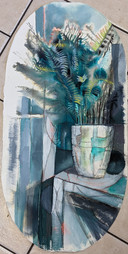
Tondos had been exciting and challenging. The single edge of the circumference leads the viewers eye to the centre of the picture. Focusing on design and compositional skills in a totally different format has been a learning curve for me.
I had chosen acrylics- open acrylics, acrylic inks and added glazes.
But it's almost like I can't just stay with one medium because I know that the properties of another medium will give me the required result. I realise I like to mix my media to achieve different results from techniques, for example, the fronds of the fern I painted with gouache over diluted blended inks, in my painting Rare Blue, because I knew I want a flat and opaque finish. I could achieve this with an opaque acrylic but, it wouldn't be that deep matte finish it would have a satin finish.
I want to ask myself some questions and compare some of the work from this section. I want to also compare work from earlier in this module.
What do I want to achieve with my work?
I want to make work that excites me but tells my story too, from my heart, my experience. When I create the work I want to enjoy the process and the mark making.
Who is my intended audience for my images?
This is difficult to answer. I am undertaking a degree because I feel passionate about art and I want to learn to paint, so I guess the audience is me.
Will people actually want to see the work I produce?
Grayson Perry's Art Club exhibition has answered this in a way, but I am still very unconfident in putting my work out to the public. I am not really sure which pieces are strong or good enough, if that makes sense.
How will my audience relate/resonate with or with my images?
The pieces that reflect my experiences or feelings seem to be those that people resonate with flight, travel, jet lag or aerial perspective views. I want to expand this and incorporate many cultural experiences, the atmosphere of places, the air humidity, the sun on your face the transitions of the light. I can recall the memory of many places, the smells, the taste of the food, the landscape of the place and I want to put them on a canvas. When I look around my house objects remind me of where I bought those objects, where I was and how I felt.
What medium can I use to evoke the feeling or communicate the narrative in the best way?
At the moment this is acrylics, inks and mixed media. I know I want to use oils in the future. I think this needs to be in a studio though as I really cannot tolerate the fumes even with water based products.
What have I learnt in this part of the course?
Drawing gives me the opportunity to experiment with a variety of compositions.
Drawing makes a painting less daunting, by creating initial concepts in raw formats.
The underpainting or sketch colour is fundamentally important for me, as some of it will be seen through the layers of my work.
The colour of the underpainting can have a massive effect on the feel or emotion of the piece.
Varnish has properties to make matte or gloss areas in my work which can amplify areas (for different reasons if required) over acrylics, is especially effective.
A thicker paint application over my base layers makes underlayers recede with texture or opaqueness.
The shape of the canvas can have an effect on the direction the viewer's eye.
The ways of looking at an object from above or below brings new perspective for the viewer.
Reading about different ways to view you environment opens up new perspectives and narratives for the painter.
Informing my practice with others artists techniques and looking at their work helps me to develop my own paintings. By dissecting and looking deeply into the way artists have built up their pieces helps me to decide if I want to take these concepts further. I feel my understanding of this is becoming more confident.
Coloured grounds or colour blocks under my work, create intrigue. Vivid colour pops in my work bring energy. Layers also deepen the overall tone and richness of my work.
What do I need to be aware of for my assignment piece?
I need develop my tutor feedback I was given, for example, continue with the theme from my experiences, be confident in my mark making, don't overwork pieces and consideration of what the paint will do through using a range of broader brushes.
I feel I want to work bigger and will make a few larger experiments towards my assignment piece. This will enable me to be more free with broader strokes.
Be aware of the many mediums I can use to enhance or develop my work, adding intrigue, vibrancy or opaque finishes together along with variation of line are all elements to consider.
Which pieces do I consider the strongest so far and what do I notice about them?
Below are five pieces I have selected as,I believe, they are the strongest so far in this part of the course.
I notice that I am using green/teal/lime and pale blue colour hues in a lot of my work in this part of the course. These are the colours of the sky and the earth.
I seem to like organic lines and natural subjects more than hard linear lines. If I have a subject like the teapot I still include organics (in the background).
Ways of looking at my compositions plays an important role.
I am beginning to see what I can develop and how I can further investigate subjects by looking at my work as a group.
I realise that my experience and interest in why I am painting or drawing objects is creating tension in my work for example the aerial views of plants and the layering of artificial colours and medias.



Looking back on my work from previous parts of the course (and selecting some of the work that my tutor suggests is strongest) can I get overall feel for my work?
I seem to be developing my techniques, for example, by being more experimental with acrylic ink and diffusion, with layering and using vivid colour hues and styles of painting with geometric elements from historical research.
And so, now I start my research for the assignment piece.




Comments